Thursday, May 3, 2018

Waiting for Godot ... or is that Guffman?

Yep, any day now, spring will arrive bringing warmer weather. Any day now ... should be here shortly. If there was such a thing as 'your Spring (check) is in the mail' this year would be it. I know parts of the country are just now shedding snow but here in the Bay Area the weather usually warms up in early March. Not early May. Among other things, this means that many of the plants in our gardens are late. Or not. Some plants growth and blooming cycles are triggered as much by the length of the day as by amount of sunshine or rain.
On a completely different note, I wanted to let people know about the Amazon Spheres, 3 work/greenhouse domes in Seattle. Here's the website. https://seattle.curbed.com/2018/1/30/16947838/amazon-spheres-seattle-architecture-photos. The two photos I've included here will give some idea of these amazing structures and interior design but I encourage going to the article.
Today, once more, it's photos of my garden, as the cornucopia of spring continues.


No shrub is more aptly named than the Marmalade bush (Streptosolen jamesonii). Like that famous jam, this evergreen shrub produces flowers in an array of colors - from golden yellow through brilliant orange. One little know fact about this shrub - it's irresistible to hummers.


"Is that a Eucomis 'Sparkling Burgundy' or are you just happy to see me?"  The new shoots of this pineapple lily certainly are a vivid burgundy. They'll age to a dark green but for the first month the leaves hold onto this rich tone.


Speaking of vivid burgundy colors, this Chantilly Purple snapdragon from Annie's offers velvety colors. One of the deepest colors in the world of snaps.


I've mentioned my love of lilies. Here's a closeup of the first one to bloom this year, an Asiatic type called Orange Electric. Love the color and pattern.
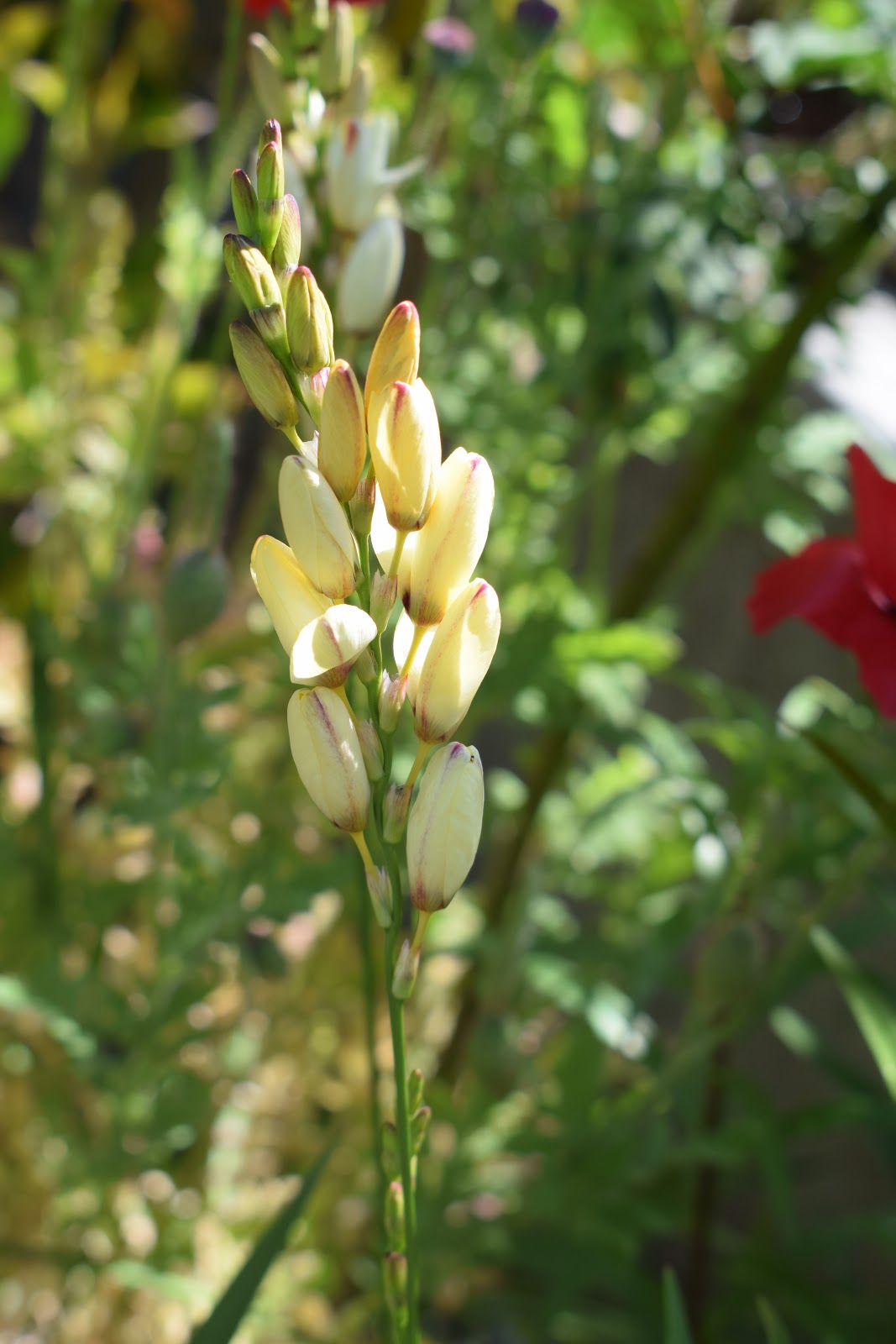

Yellow Ixias (corn lily) are less common but here's a new one in my garden called 'Yellow Emperor.' Don't know about the emperor part of the name, though Napolean was like 5' tall, n'est-ce pas?


Blechnum gibbum 'Silver Lady.' This is one of the so-called 'shuttlecock' ferns, which you get a better idea of from this top down shot.


Cyptomerias often have lovely golden new growth and that is the case this spring for my C. Sekkan-Sugi. Commonly known as Japanese cedars, did you know that the genus name translates as "hidden parts." Beautiful and varied, there are a number of dwarf varieties, this being one of those. 


When you say 'milkweed' most gardeners will immediately think of Asclepias. Fewer know that this blue-flowering charmer - Tweedia caerulea - belongs to the same family (Apocynaceae), making the same fluffy seedpods and having the same milky sap. Robins-egg blue anyone? 


Believe it or not you can buy conifers in 4" pots (usually in your nursery's Bonzai section). Here I've put a Chamaecyparis pisifera ‘Plumosa Compressa,’ Cryptomeria japonica ‘Black Dragon’ and Pinus contorta v. murrayana in one pot.


Yes, Tillandsias DO bloom. Here's an unidentified species with a very popular color combo for air plants - pink and purple.


"I spathe, therefore I am." That could indeed be the motto for most Jack-in-a-Pulpits (Arisaema). Here's my A. griffithii v. pradhanii. This species has a particularly unusual and vivid spathe so I can't wait!


Choisya 'Sundance.' It took awhile but this golden Mock orange is now flowering every year. New leaves are golden then fade to a ever changing pattern of green and gold.


No one can seem to ID this fern but that's okay. It's beautiful. Here you see the new fiddleheads unfurling. 


My Clematis Josephine continues to unfold, adding new rings of petals. Here the filtered light gives it a softer appearance. 


Thatza California! Here are two CA natives, the patterned gold leaves of Tolmiea 'Taff's Gold' and the solid green leaves Of Maianthemum, with its radiating lines. The former stays evergreen while the spreading latter goes dormant in winter. 


Phacelia viscida + bumblebee. I always tell people - Ace customers and neighbors alike - that there's no reason to be afraid of bees (unless you're deathly allergic of course). Bees are intent on collecting nectar and nothing else. You literally can stick your face inches from them while they're harvesting nectar and they'll ignore you (pretty amazing when you consider the scale - our faces would be as big as skyscrapers). 


Callistemon viminalis. This dwarf bottlebrush shrub is hitting its stride here in year three. The flowers wouldn't seem to be ones that hummers would like but I see them on my plant every day.


One nice thing about putting bulbs in pots is that you can plant something low growing on top. Here I've put a sunrose (Helianthemum) over some species gladiolas. You can see them poking up. 


Most people are familiar with Tea trees. They get big and usually feature pink or red flowers. Here's the exception, a 10' high, white-flowering species (Leptospermum 'Lanigerum'). Although the flowers are pretty, I bought this one for its soft, silvery foliage.


To paraphrase the Bard "To Variegate or not to Variegate." This Euonymus aureo-marginatus is supposed to have patterned green and gold leaves (it did when I bought it) and if you look closely the lower leaves are indeed variegated. The question is: are the golden new leaves going to stay golden or will they acquire their intended variegation? 


File this Fuchsia autumnale under the category 'Don't care if it flowers.' Such pretty leaves!


You can be forgiven if you don't recognize this plant as a wisteria. It's a dwarf, bush type variety called Kofuji. It's supposed to only get 2-3' tall. It didn't bloom in its first full year in my garden but that's okay. I love the delicate foliage.

Thursday, April 26, 2018

Spring's Abundance

Today a picture is (hopefully) worth a thousand words, so just photos of my spring garden with a few thoughts on each plant. Enjoy!


Dappled light on my hard to find Asarina procumbens. Thanks to Barb Siegel for growing this little charmer. It goes completely deciduous but leafs out reliably in spring. If you look closely, you'll see the soft white tubular flowers.


Tricyrtis variety. Toad lilies are nothing if not vigorous and mine always gets an early start leafing out. Apart from the charming spotted flowers that appear in summer, toad lilies are a nice way to add lush green foliage to a morning sun bed.


Clematis 'Josephine.' This double form clematis is gradually opening its inner layers of petals. I accidentally severed its wiry stems the first two years (arghh!) so this is the first bloom I'm getting to marvel at.


I'm slowly amassing a caudiciform collection and this addition from last year, Pachypodium
lealii v. saundersii, is beginning to leaf out.


Want blue flowers all summer? Evolvulus is a good choice, putting out a seemingly endless array of little 1" true blue flowers from mid-spring through late summer.


We don't normally think of Scabiosas (Pincushion flowers) as ground covers but my S. 'Harlequin' has stayed low and spread. As you can see, it's in full bloom and always has bee visitors gathering nectar. Tough, durable, pretty and loved by pollinators. So, basically, all good.


Papaver Orange Chiffon. Quite possibly the most saturated orange in the entire world of flowers. Vivid!


Speaking of orange, here's a new Geum in my garden. It's G. 'Georgenberg.' I love the foliage on geums almost as much as the flowers.


Any regular reader of this blog knows I'm a bulb fanatic and more specifically a big fan of lilies. Here's a new one - L. 'Orange Electric.' Though it looks at first like it has orange petals, a closer look reveals that the petals are white with prominent orange ribs plus dark spotting. Lovely!


My Cotinus 'Royal Purple' is a bit late leafing out is making up for lost time and already has the beginning of the famous 'smoke' flowers that give this tree its common name.


I know I'm biased, feeling that this Veldfire variety of Leucospermum is the most beautiful of all the Pincushion shrubs but this photo gives you an idea as to why. 


There's nothing quite like the red of Ladybird poppies (Papaver commutatum), especially since a single plant will produce dozens of brilliant red flowers in its short lifespan.


Chamelaucium 'Bridal Pearl.' An Aussie native so you know it's tough, this evergreen shrub puts out tiny pink flowers in spring. Blooming last over a 3 month period, giving gardeners (and bees) a good long while to enjoy its delicate charms. 


For those of you who know your Irises, I. pseudacorus normally has a fairly plain yellow flower. Here, this I. 'Holden Clough' variety offers much showier flowers. This Iris species likes moist conditions so is good near a pond or in a semi-bog area.


Now well established, this Abelia sp. 'Chiapis' offers the loveliest lilac-colored blooms. Surprisingly sweet-scented too.


Everybody loves columbines and I'm one of those. Here's a simple purple and white variety called 'Rocky Mountain.' 


Speaking of hardy and reliable irises, here's another shot of my Iris douglasiana. Simple but charming and it is great for colonizing a filtered sun or bright indirect light bed. 


My Dicentra scandens is back and already has its first lemon-yellow flowers. I've written extensively about this plant but there's a reason for that. It is far more vigorous and reliable than most bleeding hearts; it's the only one I know of with yellow flowers; it's likewise the only climber and it is such a prolific bloomer over a much longer period than other Dicentras.


Abutilon thompsonii. Here I tried to catch the sun outlining the delicate veining in this flowering maple species. Such a beautiful color too.


Fallopia japonica variegata. It's all about the speckled foliage with this deciduous perennial. It likes some shade so I have mine in the back yard where it gets a couple hours of morning sun.


Here are two shots of my Snowball viburnum (V. opulus). Apart from it being one of the most unusual flowering shrubs - how many other shrubs have masses of perfectly round 'balls' that turn from green to pure white? - it is incredibly quick to flower after leafing out. Hey, where's the fire? The close-up below shows the first of the flowers acquiring that pure white hue.


Hydrangea quercifolia (Oakleaf hydrangea). Here's the first stage of the conical flower clusters. This species is tough, liking more sun and able to stand periods of dryness better than mophead or lacecap Hydrangeas.


Camellia 'Black Magic.' One of the deepest reds in the world of Camellias. And it has a waxier, sturdier flower to boot. Unique and beautiful!


Geranium phaeum. I love the 'matte' finish of the purple flowers. 


Tolmiea menziesii 'Taff's Gold. The golden form of the Piggyback plant. Charming and tough.


Syringa meyeri 'Palibin.' The mighty mite of Lilac bushes, this dwarf form nonetheless is putting on a nice show only in year two from a 4" pot. 


Allium cernum. One of ornamental onions that puts out sprays of tiny star-shaped flowers (in the case of A. cernum the flowers are white). Petite charmers.


Centaurea 'Blue Diadem.' One of types of annual Bachelor's Buttons. If you're wondering where that common name came from Wikipedia notes "In folklore, cornflowers were worn by young men in love; if the flower faded too quickly, it was taken as a sign that the man's love was not returned." They also note "its edible flower can be used for culinary decoration, for example to add color to salads. Cornflowers have been used and prized historically for their blue pigment. Cornflowers are often used as an ingredient in certain tea blends, including Twinings' Lady Grey tea. 


Dianthus variety. I like carnations not just for the dizzying array of flower colors but for the bluish foliage of certain types.


Papaver atlanticum 'Flore Pleno.' This Moroccan poppy is set apart from other poppies by it being perennial, very drought tolerant once established and for its crazy long blooming season.


Justicia brandegeeana. I once joked that this plant was polyamorous. He (or she) has three lovers - Brandy, Gee (a filipina name) and Ana. Okay, moving right along ...


Pulmonaria variety. This tougher than it looks deciduous perennial likes some relief from the heat of midday. It produces bluish-pink flowers in spring and as you can see, features heavily spotted leaves.


The color of this Aquilegia 'Blue Barlow' is really shown off by the sun back lighting its deep maroon petals. A small double form, it is proof that good things do come in small packages.
 
01 09 10