I've had a bit of a break but am back with not one but two new posts. This first is more the usual order, photos of plants in my garden, accompanied by comments. The second will be a posting of an upcoming Chronicle column on Large Non-Spiny dry garden plants.
Without further adieu, here are the photos.
Cornus florida. Most dogwoods offer great fall color and mine is one of those.
Agave tricolor. A new addition to my garden. Thorny but oh so beautiful.
Two Billbergias, adding texture even when not in bloom.
A friend gave me this bluebird door knocker and I decided the fence was a better (and more visible) location.
There are summer oxalis and winter oxalis. Here's one of the latter, with its mint green leaves and white flowers.
Some Moraea flowers are extravagant, such as the Peacock Moraea. This M. polystacha's flowers are simpler but still a very pretty dusky purple.
My Asclepias cancellata went bonkers in the blooming dept this year. Literally thousands of tiny white flowers. I knew the butterflies would like the flowers but the big surprise is how much the bees love them.
My sunny front bed is still sporting lots of color. There's the red Digiplexis, a red mimulus and a yellow, the CA Fuchsia (Epilobium) pinkish-red flowers to the right and not quite visible another wonderful milkweed - Tweedia - with its sky blue flowers.
Aloe arborescens variegata. One of the 'soft' aloes, it is gradually maturing. No flowers yet but they will come in time.
Echeveria gibbiflora. This species of Echeveria is noteworthy for its dramatically fluted leaves.
Correa is one of my favorite shrubs. This Aussie native can thrive in sun or some shade, in good soil or poor, with regular water or dry conditions. This is a new variety simply called 'Orange.'
Agastache is truly an amazing plant. This hummingbird mint always seems to be in bloom! Plus the fragrant leaves, the regular visits by not just hummers but bees as well.
Tillandsia tectorum. My favorite 'air plant.' That's mostly for the exquisite silvery foliage and the way it has clustered out.
Big event this week was my 2 year old Plectranthus chirindensis FINALLY blooming! You can see why I'm excited. Electric blue flowers that are unlike nearly any other plant. It's huge too, easily 8' tall now.
To quote Foghorn Leghorn from the Bugs Bunny show "I say, I say, I say HOLD ON THERE son!" That would be a suitable directive for dwarf conifer species in a bowl, where the plan is to sort of bonzai them.
I came acroos this rare shrub Trochetiopsis ebenus. Thought to have gone extinct, it's been preserved in the horticulture trade.
Lastly, 3 new additions to my succulent collection - Echeveria variety on the left, Aeonium Sunburst up top and Sempervivum tectorum Greenii on the right.
Tuesday, November 12, 2019
Monday, October 21, 2019
Got Dry Shade?
As we become more and more conscious of our water use, there is an emphasis on planting drought tolerant plants. And that includes for shady spots. Curiously, people tend to be more familiar with drought tolerant plants for sun than those for shade. I recently gave a talk out at Annie's Annuals on this very topic and in preparing for the talk I made an outline. Yesterday, it occurred to me that while this is indeed only a summary/outline, it might still prove helpful to some of those who follow this blog. Two things to note about the plants listed. First, since this was a talk at Annie's I naturally focused on plants they sell. And second, somewhat related to the first point, I did not include any trees and very few shrubs. They too would be good choices.
So, here it is, in its unvarnished glory. Hope it's helpful!
4 Kinds of Shade
- Full morning sun (MS)
- Two to three hours of morning sun (PS)
- No direct sun but bright shade (BS)
- Dark shade (DS)
Oakland Shade vs Fresno
Shade
Interpreting
what books say about shade or sun depending on where you live.
Adjusting up ½ a sun factor for the milder zones.
The
list below is divided into groups per type of plant. They are
designated by the most amount of shade they will prosper in. Thus, a
plant designated BS (for bright shade) will also handle PS and MS
unless noted. Selections with a CN
are California natives. All plants listed are perennial with the
exception of Nicotiana, which often reseeds.
Planting Shade
Perennials
- Planting by season.
- Watering to establish then cutting back.
- Mulching to save water
- Slugs & snails. More prevalent in shady areas. Treatments.
- Deer. Most of the selections here are either deer proof or will discourage them.
- Maintaining shady areas. When to cut back. When to remove.
Shrubs (Planting
foundation plants first)
Plectranthus
(BS) – best plant for shade, all heights, leaf textures
Arctostaphylos
(BS) CN – good foundation plant; RPBG selections
Sarcococca
(DS) – Winter box offers fragrant late winter flowers, handles deep
shade
Mahonia
(BS) CN – tough & durable, yellow flowers, all sizes
Perennials (For adding
texture and color)
Francoa
(PS) – tough, clumps out, summer bloomer
Hellebores
(BS) – cut back foliage to ground in late fall; treating white
flies
Heuchera
maxima (BS) CN – year round appeal, largest Coral bells
Nicotianas
(PS) – many different types, colors, heights, fragrant
Ground covers (For
filling in bare spots or as a natural weed control)
Asarum
caudatum (BS) CN – tough, heart-shaped shiny leaves, curious
flowers
Rubus
(BS) – rough textured leaves, tenacious, beautiful, prostrate
Ajuga
(PS) – light or dark leaves, establishes easily, wants a little
water
Geranium
Rozanne (PS) – one of many true geraniums that spreads, showy
flowers
Tellima
grandiflora (BS) CN – charming heuchera-like flowers, stays
neat
Epimedium
(BS) – tenacious, 1-2' tall, charming small flowers of different
colors
Ferns (There are
several choices for adding that special look that only ferns give)
Leatherleaf
fern (Rumohra adiantiformis) (BS) – survives dry spells but better
with H2O
Western
Sword fern (Polystichum munitum) (BS) CN –
one of our toughest ferns!
Grasses (Good choices
for areas that get light traffic)
Carex
pansa (MS) – tough evergreen grass that can even handle light foot
traffic
Ophiopogon
planiscapus (BS) – black mondo grass, provides great color,
adaptable
Succulents (Succulents
go well with grasses or phormiums)
Aeoniums
(BS) – large leaves, some colorful, prefers some shade; frost
damage
Sedum
Angelina (PS) – fast spreading ground cover; more golden in sun
Phormiums/Cordylines
(PS) – tough plants for adding leaf texture and color
Vines (Though most
popular vines like sun there are plenty for shade)
Jasminum
Pepita (PS) – smaller variety of pink jasmine, fragrant,
establishes easily
Solanum
Navidad (PS) – one of the showiest potato vines (purple flowers),
tenacious
Bulbs (Though not as
well known there are bulbs that prefer a bit of shade)
Brodiaea
'Rudy' (MS) CN – naturalizes easily, purple flowers, early
summer blooms
Iris
douglasiana (BS) CN – most resilient of all irises, spring
bloom, colonizes
Iris
confusa (BS) – pretty white or lavender (Chengdu) flowers, sun or
shade, any soil
Sunday, October 13, 2019
Who's Zoomin' Who?
Aretha Franklin fans will catch the title of this blogpost but for me it's about the matter of today's photos. Today I used my zoom lens to take close-ups of flowers. Ironically, a lens that's usually used for long distance shots turns out to be good for photographing smaller flowers. And now that I have a body that supports Auto-focus, it can focus itself, rather than me relying on a steady hand.
So, that said, here are some mid-October photos showing that yes, it's still late summer, no matter what the calendar says.
Azalea Court Jester. This sport is from Kenny at Moraga Garden Center. The flowers can be all different, one from the other, with some showing more orchid pink streaking and others less.
Hibiscus trionum. Still one of gardening's best kept secrets. This lovely, herbaceous hibiscus is a prolific bloomer, with buds seeming to develop overnight. Though there's just the one color - a creamy white with burgundy centers - they bloom over a long season in summer and fall.
I think some people naming varieties of plants must be doing so after fasting. So many food names. Here's another one - Justicia Fruit Cocktail. It too is a prolific bloomer. Love the chartreuse bracts!
Nerine humilis.This South African bulb has the prettiest coral flowers.
Opuntia species. Still have yet to nail down the species or variety of this prickly pear cactus and am still waiting for it to bloom.
You need a zoom to catch the petite charms of the small Evolvulus flowers. One of the truest blues and for me a reliable and long blooming perennial.
There are summer oxalis and winter oxalis. Here's a winter blooming type that's come up a bit early. Love the contrast of the white flowers against the mint green leaves.
Monardella odoratissima. This long blooming Coyote mint has been a real standout in my garden. Seemingly always in bloom, it attracts a variety of butterflies and moths.
Agastache Blue Fortune. This Hummingbird mint also attracts bees (as do most of my Agastache). I seem to be in a purple phase these days.
Santolina Lemon Fizz. This diminutive herb/ornamental has its own charm, from its petite form, to the bright chartreuse color to its scent (which some like and others do not).
My Mandevilla Apricot is late to bloom this year (as are many things in my garden). Here's its first flower of the year. Incidentally that streak of white on the right side is sap from the towering Asclepias cancellata above it. I'd snapped off a couple of leaves for a less obstructed view and they bled onto the flower.
Digiplexis Illumination Flame. I seem to alternate between good years and bad for this plant. This year's been a good one and I'm sure there's plenty more flowers to come.
Cussonia natalensis is considered a caudiciform and here's evidence of that. This fattening trunk still holds some gnarly charm.
This Hibiscus Adonis Pearl is part of the HibisQs line, a new hybrid of Hibiscus whose flowers stay open much longer than traditional Hibiscus (5-6 days as opposed to 1-2 days).
My Sphaeralcea Newleaze Coral has been nothing short of amazing. In bloom continuously since February, it just keeps pumping out these sweet half inch coral-red blooms.
I'm thinking of naming this Freylinia 'Shelley', after the Sesame Street turtle. That's because it's one of the slowest growing plants I've ever had in my garden. Month to month this Aussie native hardly seems changed.
My Tecoma x smithii is the opposite to the Freylinia. Quick to grow, quick to take over an area, quick to bloom. Which is all good for me as it can't escape anywhere. Here's a close-up of its richly colored flowers.
A zoom lens is needed to do justice to the tiny but oh so blue flowers of Ceratostigma plumbaginoides. The low growing form of Plumbago, it adds tints of red to its leaves in winter.
Emilia. This annual offers up the orangest flowers going, even if they're tiny. Here my auto=focus couldn't quite get it right so not a perfect shot.
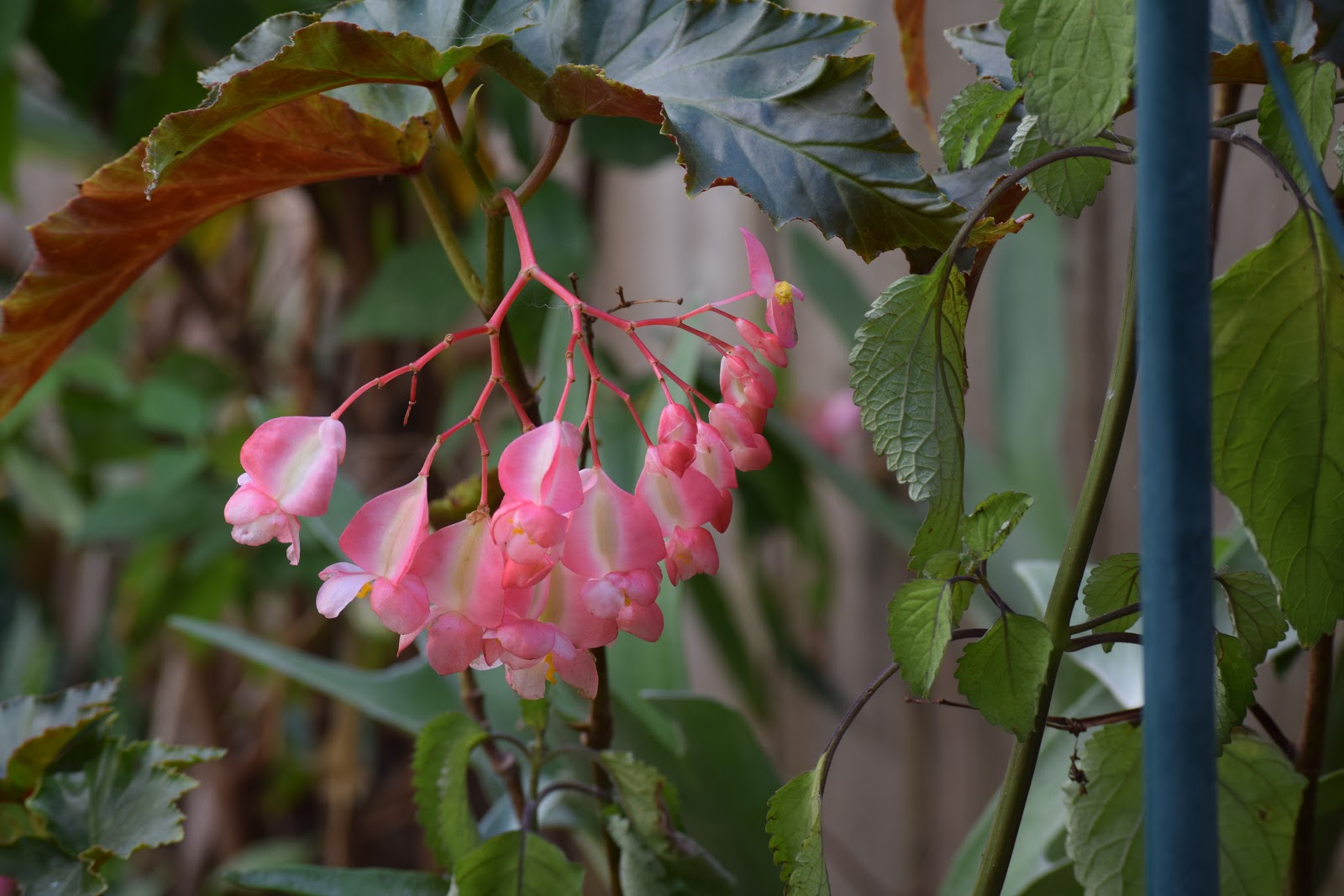
My Begonias are all late this year, including my Irene Nuss. Here's a late spray of its signature two tone pink flowers.
My Angelwings begonia is also late and in need of repotting but still has enough beauty to photograph.
So, that said, here are some mid-October photos showing that yes, it's still late summer, no matter what the calendar says.
Azalea Court Jester. This sport is from Kenny at Moraga Garden Center. The flowers can be all different, one from the other, with some showing more orchid pink streaking and others less.
Hibiscus trionum. Still one of gardening's best kept secrets. This lovely, herbaceous hibiscus is a prolific bloomer, with buds seeming to develop overnight. Though there's just the one color - a creamy white with burgundy centers - they bloom over a long season in summer and fall.
I think some people naming varieties of plants must be doing so after fasting. So many food names. Here's another one - Justicia Fruit Cocktail. It too is a prolific bloomer. Love the chartreuse bracts!
Nerine humilis.This South African bulb has the prettiest coral flowers.
Opuntia species. Still have yet to nail down the species or variety of this prickly pear cactus and am still waiting for it to bloom.
You need a zoom to catch the petite charms of the small Evolvulus flowers. One of the truest blues and for me a reliable and long blooming perennial.
There are summer oxalis and winter oxalis. Here's a winter blooming type that's come up a bit early. Love the contrast of the white flowers against the mint green leaves.
Monardella odoratissima. This long blooming Coyote mint has been a real standout in my garden. Seemingly always in bloom, it attracts a variety of butterflies and moths.
Agastache Blue Fortune. This Hummingbird mint also attracts bees (as do most of my Agastache). I seem to be in a purple phase these days.
Santolina Lemon Fizz. This diminutive herb/ornamental has its own charm, from its petite form, to the bright chartreuse color to its scent (which some like and others do not).
My Mandevilla Apricot is late to bloom this year (as are many things in my garden). Here's its first flower of the year. Incidentally that streak of white on the right side is sap from the towering Asclepias cancellata above it. I'd snapped off a couple of leaves for a less obstructed view and they bled onto the flower.
Digiplexis Illumination Flame. I seem to alternate between good years and bad for this plant. This year's been a good one and I'm sure there's plenty more flowers to come.
Cussonia natalensis is considered a caudiciform and here's evidence of that. This fattening trunk still holds some gnarly charm.
This Hibiscus Adonis Pearl is part of the HibisQs line, a new hybrid of Hibiscus whose flowers stay open much longer than traditional Hibiscus (5-6 days as opposed to 1-2 days).
My Sphaeralcea Newleaze Coral has been nothing short of amazing. In bloom continuously since February, it just keeps pumping out these sweet half inch coral-red blooms.
I'm thinking of naming this Freylinia 'Shelley', after the Sesame Street turtle. That's because it's one of the slowest growing plants I've ever had in my garden. Month to month this Aussie native hardly seems changed.
My Tecoma x smithii is the opposite to the Freylinia. Quick to grow, quick to take over an area, quick to bloom. Which is all good for me as it can't escape anywhere. Here's a close-up of its richly colored flowers.
A zoom lens is needed to do justice to the tiny but oh so blue flowers of Ceratostigma plumbaginoides. The low growing form of Plumbago, it adds tints of red to its leaves in winter.
Emilia. This annual offers up the orangest flowers going, even if they're tiny. Here my auto=focus couldn't quite get it right so not a perfect shot.
My Begonias are all late this year, including my Irene Nuss. Here's a late spray of its signature two tone pink flowers.
My Angelwings begonia is also late and in need of repotting but still has enough beauty to photograph.
Tuesday, October 1, 2019
The bell has struck October!
Hard to believe it's already October. Our usual signs of this time of year - much warmer weather, lots of wildfires, gardens still flush with late summer flowers - are all largely MIA this year. As to the fires, well that's obviously a good thing. Our gardens seem to march to their own drummer. I still have groups of plants in bloom, most notably Salvias, Mimulus and Agastache. My Epilobium is in full bloom, keeping the bees and hummers happy. While the Begonias didn't do as well this year, my small collection of Calibrachoas has.
Here are a few of the garden's treats, shot over the last three days.
Nerine humilis. It took 3 years for this bulb to bloom but I love the color and the spidery petals.
One of my three Calibrachoas that's done well, this Holy Smokes has benefited from a sunny location and regular water.
Rhodocoma capensis. This lovely Restio has done well and it nicely softens this alcove between cement steps and stucco walls.
Epilobium canum. Though I have to keep trimming it back, its nonstop flowering and bright colors make this the perfect plant to soften a wrought iron railing.
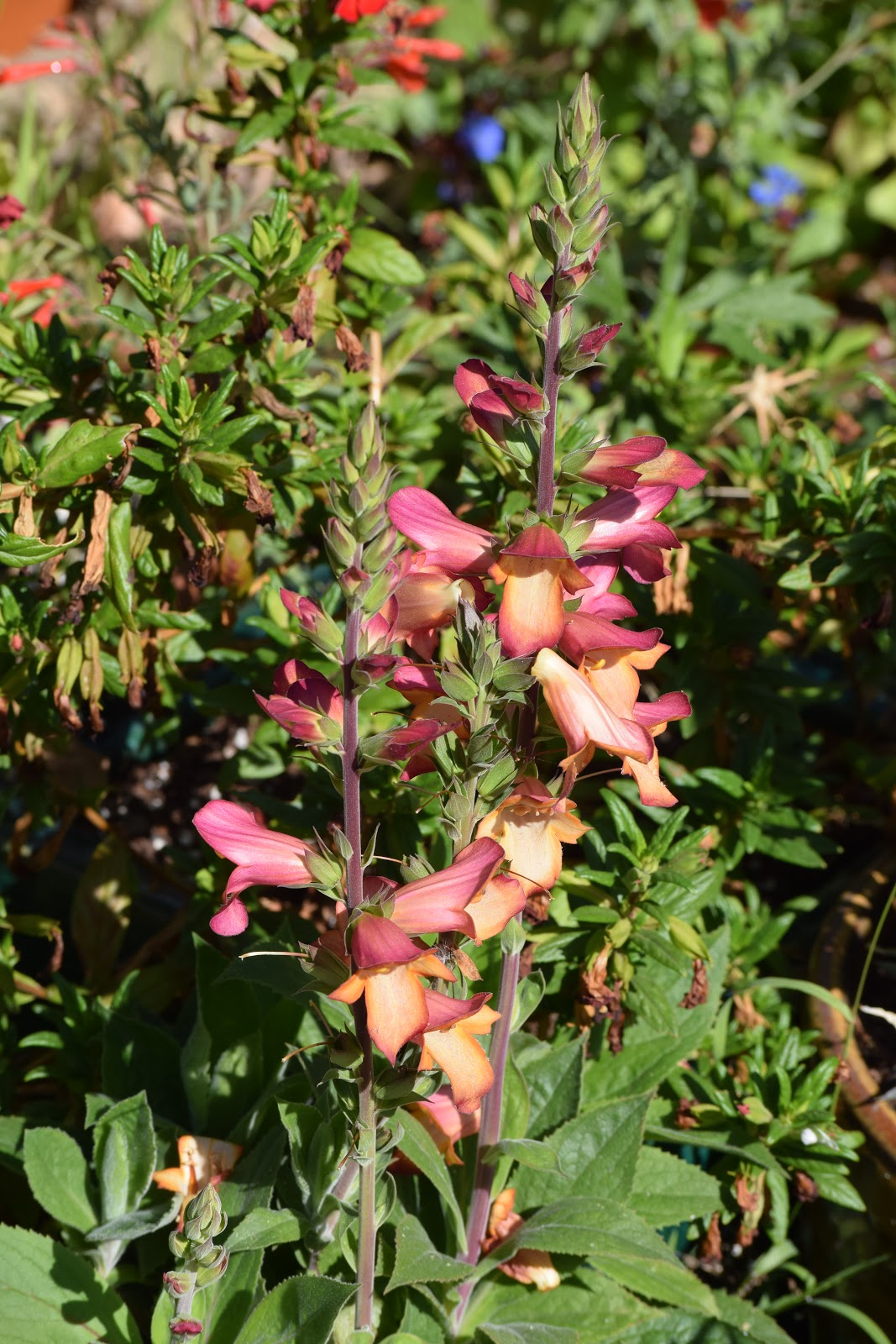
This Teucrium aroanium and orange Snapdragon are compatible neighbors. Sun lovers situated at the front of our walkway, they take up the task of greeting visitors.
Petchoa. This cross between a Petunia and a Calibrachoa has been a blooming miracle. To quote Michael Nesmith (shout out to you Monkees and/or alt-country fans) "And the hits keep comin'!"
Those orange tubular flowers belong to Aloe rooikappie. This new addition to my dry garden bed is sure to attract lots of hummers.
My marmalade bush has bounced back from a severe pruning 18 months ago, back stronger and more floriferous than ever. Speaking of hummers, this is one of their favorite destinations. Maybe they're English hummers. (Marmalade ... England ... Oh, never mind).
My lovely Agastache Blue Fortune is just getting going on the blooming front. Here's a bee coming to check out the flowers.
Though Staghorn ferns get their common name from the antler-shaped fronds, for some - me included - the basal frond is just as interesting. Here it is on my still growing Staghorn.
Mossy soft shield fern. This guy bounced back from a bad case of thrips and is looking good.
Here are my two favorite non-flowering Begonias right now. That's a B. Gryphon on the left and a B. acetosa on the right.
Here are two of my recent Billbergias. Though it's hard to tell from this photo, the one on the right is whiter than it looks, leading to its variety name Billbergia Casablanca.
I finally had some luck with seeds this year and one of them was this Mirabilis Marbles Mix. The close-up photo below gives a better view of its marbled colors. Pretty!
I cut my Hibiscus 'Cherie' back hard last year and it was slow to recover. Believe it or not this is its first flower of the year! In October! Hopefully it will make up for its late start.
This Salvia leucantha 'Danielle's Dream' offers fuzzy white bracts, from which bright pink flowers eventually sprout.
Hibiscus Adonis Pearl. This is one of the first in the HibisQs series, which feature flowers that stay open much longer than traditional Hibiscus flowers. It returned nicely here in year two.
My Dwarf Conifers garden continues to prosper.
This is a new Opuntia variety someone sold to our Ace nursery but then forgot to include hort info for. So I've put a word into our dry garden expert for the proper ID. I liked the chartreuse coloring.
Begonia Irene Nuss. Also late but now starting to flower.
The Rex begonias are all late this year (at least in my garden). This new B. rex Festive Celebration is perking up and has sprouted its first flowers.
Here are a few of the garden's treats, shot over the last three days.
Nerine humilis. It took 3 years for this bulb to bloom but I love the color and the spidery petals.
One of my three Calibrachoas that's done well, this Holy Smokes has benefited from a sunny location and regular water.
Rhodocoma capensis. This lovely Restio has done well and it nicely softens this alcove between cement steps and stucco walls.
Epilobium canum. Though I have to keep trimming it back, its nonstop flowering and bright colors make this the perfect plant to soften a wrought iron railing.
This Teucrium aroanium and orange Snapdragon are compatible neighbors. Sun lovers situated at the front of our walkway, they take up the task of greeting visitors.
Petchoa. This cross between a Petunia and a Calibrachoa has been a blooming miracle. To quote Michael Nesmith (shout out to you Monkees and/or alt-country fans) "And the hits keep comin'!"
Those orange tubular flowers belong to Aloe rooikappie. This new addition to my dry garden bed is sure to attract lots of hummers.
My marmalade bush has bounced back from a severe pruning 18 months ago, back stronger and more floriferous than ever. Speaking of hummers, this is one of their favorite destinations. Maybe they're English hummers. (Marmalade ... England ... Oh, never mind).
My lovely Agastache Blue Fortune is just getting going on the blooming front. Here's a bee coming to check out the flowers.
Though Staghorn ferns get their common name from the antler-shaped fronds, for some - me included - the basal frond is just as interesting. Here it is on my still growing Staghorn.
Mossy soft shield fern. This guy bounced back from a bad case of thrips and is looking good.
Here are my two favorite non-flowering Begonias right now. That's a B. Gryphon on the left and a B. acetosa on the right.
Here are two of my recent Billbergias. Though it's hard to tell from this photo, the one on the right is whiter than it looks, leading to its variety name Billbergia Casablanca.
I finally had some luck with seeds this year and one of them was this Mirabilis Marbles Mix. The close-up photo below gives a better view of its marbled colors. Pretty!
I cut my Hibiscus 'Cherie' back hard last year and it was slow to recover. Believe it or not this is its first flower of the year! In October! Hopefully it will make up for its late start.
This Salvia leucantha 'Danielle's Dream' offers fuzzy white bracts, from which bright pink flowers eventually sprout.
Hibiscus Adonis Pearl. This is one of the first in the HibisQs series, which feature flowers that stay open much longer than traditional Hibiscus flowers. It returned nicely here in year two.
My Dwarf Conifers garden continues to prosper.
This is a new Opuntia variety someone sold to our Ace nursery but then forgot to include hort info for. So I've put a word into our dry garden expert for the proper ID. I liked the chartreuse coloring.
Begonia Irene Nuss. Also late but now starting to flower.
The Rex begonias are all late this year (at least in my garden). This new B. rex Festive Celebration is perking up and has sprouted its first flowers.
Subscribe to:
Posts (Atom)