The Summer issue of Pacific Horticulture magazine is out and I have an article on preserving species diversity. You need to be a member of the Pacific Horticulture Society to view content online (and to receive the quarterly magazine) and I encourage you to join (PHS website). It's a modest $50.00 and you'd be supporting the premier horticulture magazine on the west coast. Anyway, as many of you know, I've been doing a regular column for the last few years (The Curious Plantsman Looks At) but for this issue the editor kindly moved my article, which shows how city gardeners can help preserve species diversity, up to a feature article selection. Hope you can check it out.
Summer continues and it has brought a bounty to my garden. A picture is worth a thousand words so will let today's photos do the talking.
The Sun Parasol line of Mandevillas have become popular over the last few years but this new addition, called Apricot, is causing quite the stir for introducing the first apricot-gold mandevilla to the trade.
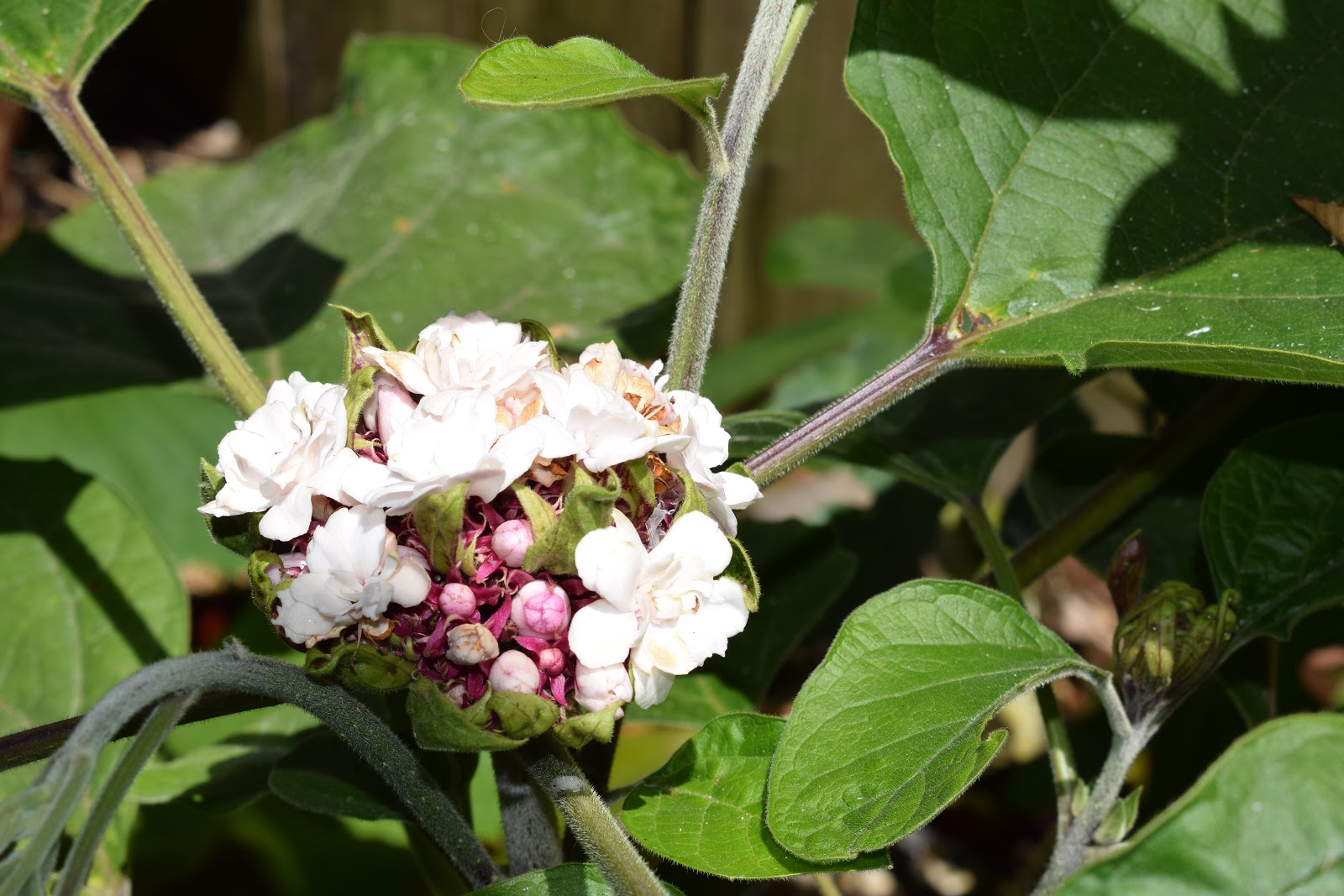
Clerodendrum fragrans. Forget what I said above about a picture being worth a thousand words. Photos can't convey how intensely fragrant the flowers on this semi-tropical glorybower are. Truly one of the most intensely sweet smelling flowers in nature. The flower buds are pink and despite what this photo seems to show, the flowers are white.
Albuca spiralis. This S. African bulb's simple yellow flowers are immensely charming, dangling on multi-branching stems.
Two shots of my Thunbergia Arizona Red. This T. alata hybrid has proven to be incredibly vigorous, which is a polite way of saying that I have to keep cutting it back so it doesn't overrun plants next to it. Love those flowers though.
Agastache Black Adder with Cabbage moth. Though it's not one of the more fragrant hummingbird mints, this variety does feature a dark blush to its leaves and pretty purple flowers.
Viscaria Blue Pearl with Gomphrena decumbens. These two neighbors make a nice combo, with the larger lavender-blue flowers of the Viscaria floating above and around the tiny burgundy button flowers of the bush Gomphrena.
Another shot of my unique Double Sensation lilies.
Who you calling a bat-face? Oh, yeah, me. This Cuphea purpurea is one of the so-called bat-faced cupheas. The red petals are the ears and the purple center is the snout.
One more shot of my lovely Eucalyptus Blue Lagoon. I love the way the myriad branches all seem to radiate out, as if they were an explosion of grayish-blue fireworks.
Tecoma x smithii. Still my favorite Tecoma, it has become a blooming machine. Just getting started for the year.
Cotyledon orbiculata var. orbiculata. Pig's Ear as it's commonly known, with bluish-gray leaves in the shapes of pig's ears (well, sort of), here are the flowers as they are starting to open.
Physocarpus 'Nugget.' This golden-leaved ninebark is one of my favorite shrubs. Apart from the charms of its fuzzy white flowers, red seedpods and peeling bark, its foliage holds onto its golden color throughout the summer.
Okay, not the best photo but this gives some idea of the beauty of this Lilium 'Mister Cas.' The apricot-orange center almost seems like a darkening of the pale yellow outer parts of the petals.
Gloriosa 'Sparkling Jip.' A new variety of Gloriosa lily in my garden, it shares the same crinkled elongated petals of the straight species. Once you've grown Gloriosas, you become a fan forever.
You only see the true color of this Laurentia axillaris's flowers with the back few in the shade. They're a lovely rich lavender color.
Here the sun kisses a Lupinus pilosus flower, seeming to illuminate it from the inside. My favorite Lupine.
The event of my garden so far this year is the opening of my first Fujian lily. Absolutely huge (easily 8" across) and showcasing a rich wine red, the flowers are dramatic to the hilt.
Not so fast says Lilium Conca D'Or, which are equally big and seem to be emitting sunshine from their centers. One of the easiest lilies to grow, it bloomed big in its very first year from bulbs.
I always have a devilish time getting a decent photo of Hibiscus trionum, as the sun bleaches out the delicate pale yellow flowers. This photo's not bad and I got two flowers at once as a bonus. Like many Hibiscus flowers, these only stay open one day.
Chrysocephalum. This ground cover is grown for its silvery foliage but damn if you never get to see it as its constantly in bloom. Well, I suppose that's a good problem to have.
And finally my Lilium regale flowers (the first three). These trumpet lilies don't sacrifice fragrance for size and beauty, making them one of my favorite lilies. Plus they return faithfully every year.
Sunday, July 15, 2018
Sunday, July 8, 2018
H2O or not H2O?
So, the dry summer is upon us once again. This is a particularly vexing time for gardeners, who struggle with what to plant and thus how much water to use. Should I plant something that will need regular water one muses. Or perhaps more to the point, should I plant 10 or 20 things that need regular water? It's a question each of us must answer separately. Certainly if one hasn't thoroughly mulched one's planting beds then now is the time. I even mulch, bark chips or gravel depending on the look I'm after, most of my medium and large-sized pots to preserve water. Make sure to water shrubs and trees deeply and thus much less often. Perhaps I am being selfish but I don't want to give up the diversity of my garden, though that includes a certain number of plants that need regular water. I'm careful with water use within my home, which helps. It is worth reminding ourselves that we live in a very dry climate, with the limited amount of water being stretched thin. Then again, I remind myself that 80% of all water use in California goes to businesses and only 20% is used by the 40 million people living in this state. That gives one pause when one thinks of water conservation.
Okay, on that cheerful note here are this week's garden photos. Enjoy!
Lilium Double Sensation. This fabulous semi-double lily offers rich red tones with creamy yellow centers and an inner set of upright petals.
My Summer Garden Asiatic lily mix initially offered pure yellow and then pure raspberry red flowers. Finally, it produced this delightful bicolor flower, borrowing the best of each.
Horticulturists know that in the final analysis it's the characteristics of the flower that is the final word on plant ID. One look at this flower and you know it has to be a Solanum family member. It is. It's Nicandra physalodes and people grow it for its lovely lavender flowers.
One of my favorite lilies this summer - L. Montego Bay. Apart from its beauty it has an intoxicating scent.
Hibiscus 'Cherie.' One of the loveliest hibiscus flowers I've come across in awhile. And many of you probably know that the flowers are edible (Hibiscus tea, anyone?)
Upper walkway bed. This upper portion is populated with Agastache, lilies (coming soon), Helenium Mardi Gras, Black lotus and Gloriosa lilies (stalks forming flower buds as we speak).
Something new in the Pel world!! This Pelargonium cordifolium 'Caroline's Citrine' doesn't even resemble most geraniums with its large soft leaves. Each has a central green blotch to add interest. Very pretty!
Not the most brilliant photo but this little known plant - Emilia sonchifolium - has the prettiest orange puff ball flowers. It's a short-lived annual but worth the 'short and sweet' experience.
Laurentia axillaris. One of my personal favorites, largely due to the great abundance of lavender 'stars', it has proven to be a reliable deciduous perennial.
File this Bells of Ireland under the category titled "Oh, I thought those were the flowers!" The green 'flowers' are in fact this plant's bracts and just now it has produced its tiny white flowers at the center of each green 'cup.'
Cuphea llavea Vienco Burgundy. Sometimes known as bat-face cupheas, this burgundy version puts out an endless stream of flowers between July and October.
Why we love CA buckwheats, reason # 6. This Eriogonum grande rubescens goes wild in the blooming department during the warm days of summer. One of THE best plants for pollinators and birds.
My Asclepias curassivica self seeded in my pot of Pavonia (of course it did) and now is in full bloom. One of the great self-seeders in the history of plants, Asclepias can colonize nearly every area where it gets a foothold. Much to the delight of Monarch butterflies.
My favorite new plant of 2018, this Tanacetum haradjanii offers the most gorgeous silvery foliage of any plant going. It's a low growing spreader and that's what it's doing in this pot.
Another type of bat-faced cuphea, this C. purpurea Firecracker offers vivid red 'ears' and an equally vivid purple 'snout.' Cupheas are much beloved by bees and hummers.
Everyone knows this guy (Tiger lily). It turns out there's all kinds of tiger lilies. I've previously shared a few, as with the golden yellow variety. More to follow.
Everything except the pizza. Okay a bit of a huh? joke but this is a pineapple lily (Eucomis) and y'know, pizza, pineapple ... Okay, moving along. This is the first white-flowering variety I've grown.
Another shot of my prolific Lilium Montego Bay.
Speaking of edible ornamentals, the seedheads on this Amaranthus Hopi Red Dye weren't just used as a dye by the Hopi Indians. All of the Amaranth seedheads were used in cooking, the seeds ground down into a meal for tortillas or some other cooked bread.
Though I'm not generally a big petunias fan, I like this prominently veined variety.
Winter Wonderland White Fairy orchid. Yep, that's the actual variety name of this orchid. It's proven to be very reliable, blooming like clockwork every year.
Got intoxicating-oh-my-god-is-that-really-its scent? You do if you have this Clerodendrum fragrans. It's a bit of a zone denial plant but I've been able to get it to work here in zone 9. The flowers exude a one-of-a-kind sweet fragrance that's almost overpowering.
The Convolvulus genus is kind of interesting, with many different species and varieties. Here's a C. tricolor 'Blue Ensign.' It features vivid purplish-blue flowers with yellow centers. Like other members of this morning glory genus, it tends to stay low and spread.
For those new to this blog, this is my Jacaranda 'Bonzai Blue.' As the name suggests, this is a dwarf form of the 50' tall tree that is so popular around the Bay Area. This bush-type only gets 5-6' tall and wide but features the same vivid purple flowers.
I lost my Conca D'Or lily a few years back and when I saw it offered in a bulb catalog I had to order it again. It came as a set of five, so all the better. Here's what all the excitement is about. First off the flowers are HUGE, some of the biggest in the world of lilies. Check out the vibrant canary yellow color at the center. That gives way to a softer yellow and eventually to white tips.
It's a bird, it's a plane ... (okay, only people over 50 get this reference). It's actually the 'helicopter' flower cluster on my massive Eriogonum giganteum. Aptly named, these plants get really big and the flower clusters, each comprised of a hundred tiny flowers, are magnets for bees, flies and wasps.
Here is my sun-dappled Neomarica caerulea. An Iris family member, it has some of the most vivid flowers in the family.
I somehow had the good idea, not all my initial ideas are good ones, to plant this Epilobium canum right next to the wrought iron fence that lines our front walkway. It looks great growing through the vertical slats and it both softens and adds brilliant color to the walkway's west side.
Subscribe to:
Posts (Atom)